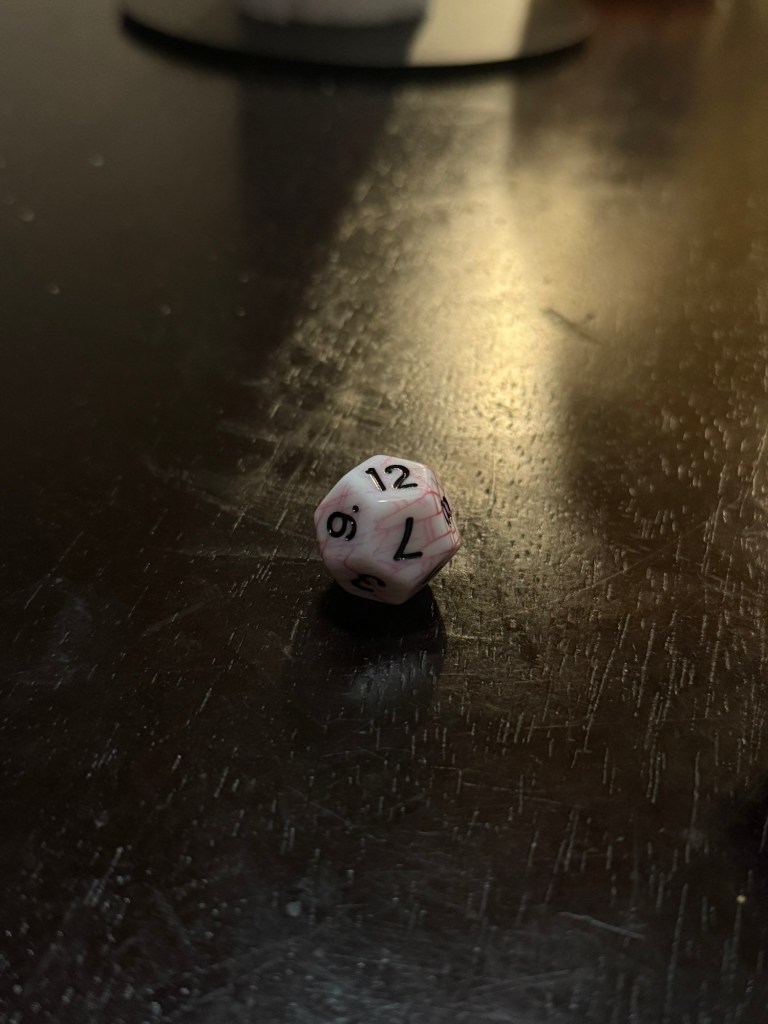
Dice Rolling Experiment
A three‐dimensional shape with 12 sides is called a dodecahedron.
I am going to be using a 12‐sided die to conduct a small experiment. This is an experiment to evaluate chance and percentage to see how random (or not) the results will be.
I am going to roll the die 120 times and record how many times each number is rolled. In theory, each number should be rolled about 10 times (since there are 12 sides, and 120 ÷ 12 = 10). Since this experiment is usually done with a normal 6‐sided die, the results should be interesting. I am going to roll the die in the same manner every time so that part of the experiment is controlled.
If I roll the same number such as a “6” for example, 60 out of 120 times I will consider this a mini black swan in my experiment. Of course, it doesn’t hold the same consequences as an actual Black Swan event, but we will use it here as example.
Results (120 rolls):
- 13 rolls
- 13 rolls
- 10 rolls
- 6 rolls
- 14 rolls
- 9 rolls
- 11 rolls
- 8 rolls
- 11 rolls
- 10 rolls
- 6 rolls
- 9 rolls
Percentages for each number (out of 120 rolls):
- 13/120 = 10.83%
- 13/120 = 10.83%
- 10/120 = 8.33%
- 6/120 = 5.00%
- 14/120 = 11.67%
- 9/120 = 7.50%
- 11/120 = 9.17%
- 8/120 = 6.67%
- 11/120 = 9.17%
- 10/120 = 8.33%
- 6/120 = 5.00%
- 9/120 = 7.50%
We can conclude that, while Black Swan events are always possible in principle, they remain extremely rare. In my dice‐rolling experiment, each number landed close to the expected average, showing typical randomness rather than extreme outliers.
In contrast, Black Swan events are exceedingly rare, unpredictable occurrences with massive impact—usually arising in large, complex systems—so they aren’t likely to manifest in a small, controlled setting like rolling dice.
I believe that if I did this experiment 100 times in a row, I would never roll the same number such as a “6” 60 times out of 120. But as a system gets more complex like our everyday lives, there are too many things out of our control that could align that would result in being even more rare than if this mini black swan was achieved. (Take this with a grain of salt based on the next 2 sentences.)
The chance of rolling a “6” for example 60 out of 120 times is one in one hundred nonillion. Which is a 1 followed by 30 zeros.
There is no way to be exact on these numbers but all of this information is just food for thought. There are endless possibilities but this dice rolling experiment is supposed to give some perspective.
For example, as I have previously mentioned in one of my earlier Daily Black Swan posts, there is a 1 in 400 trillion chance of being born. The current population is 8.2 billion people. There are billions of people in the world with free will, that sounds like a bunch of Black Swans waiting to happen.
Thats the difference between this experiment and real life. When you factor in human emotions, the current state of the world, and the increase in technological advances… well you just open up an endless discussion of potential Black Swans, not to mention the Butterfly Effect.
Although there is a greater chance of being born than rolling a “6” 60 out of 120 times it is not as simple as that. This experiment doesn’t take into account real life such as your parents meeting and everything falling into place exactly the way it did, so that you can sit there and take your next breath while reading this blog post… the Butterfly Effect in action.
There are no percentages you can put in real life scenarios that are accurate because they are not a controlled experiment like this dice rolling experiment.
I will leave at that for now, but in one of my upcoming posts I hope to cover the Butterfly Effect in full. There is much more to explore, the Butterfly Effect is one of my favorites because it’s under the same umbrella as Black Swans.
-BH
 The Black Swan Blog
Leave a comment